Overview
Monty Polish is an Android app for learning Polish by listening. It's part of Monty Network, and like everything else in the network it was designed, built and is run by one person: me.
It has one user, and that's the point. Every feature exists because I needed it on a particular day, in a shop, on a bus, or sitting at the kitchen table with my phone at three in the afternoon.
This case study follows a single word, czwartek, through the app, and explains the decisions behind each screen.
Monty Polish at a Glance
Ten days from the first line of code to version 2.3. Practice every day since the app could play its first word.
Why I Built It
I was born in the UK and moved to Poland with my wife. Polish is hard. Not a little hard: hard in the way that makes you nod and smile at the shop counter and hope the question was “Do you need a bag?”
The vocabulary apps I tried all taught the same way. Show the word, show the meaning, test the meaning. I got quite good at recognising Polish on a screen. I still couldn't understand people speaking it.
Real life works the other way round. In Poland you hear Polish long before you read it: at the checkout, on the tram, on the radio, from a neighbour out walking their dog. The app had to train that skill first.
The speaking apps were no better. Their speech checks rejected my British accent, again and again, until I stopped opening them. So I made three rules before writing a line of code.
Three rules, from day one.
It will never ask me to speak. It will never make me type. And it will always let me hear the word before it shows me anything.
The Challenge
Polish spelling is consistent, but not to an English ear. Cz, sz, rz, ś, ć and ż look like puzzles and sound like nothing in English. Read czwartek as an English speaker would, and you'll be wrong before you reach the second letter.
So the problems I had to solve were about the ear, not the eye:
- native speed is fast, and the words run together
- the stress falls in places English doesn't expect
- seeing the spelling too early teaches the wrong sound
- seeing the English too early stops you trying at all
- a test that marks you wrong for your accent teaches you to give up
And whatever I built had to fit around a real life, not a classroom: about half an hour a day, at three in the afternoon.
The Method
Listen first. Look second.
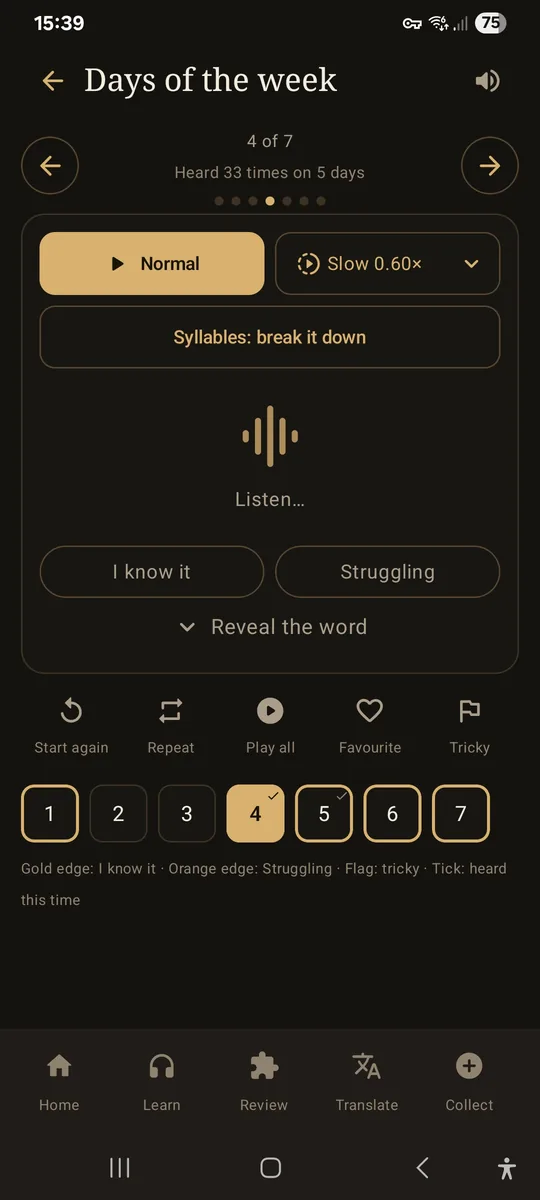
Every word opens the same way. It plays at natural speed the moment it appears, with nothing on screen but a sound wave and the word Listen…. Help is there, but only when you reach for it.
- HearAt natural speed, as it opens
- SlowTap for slower, hold to set the speed
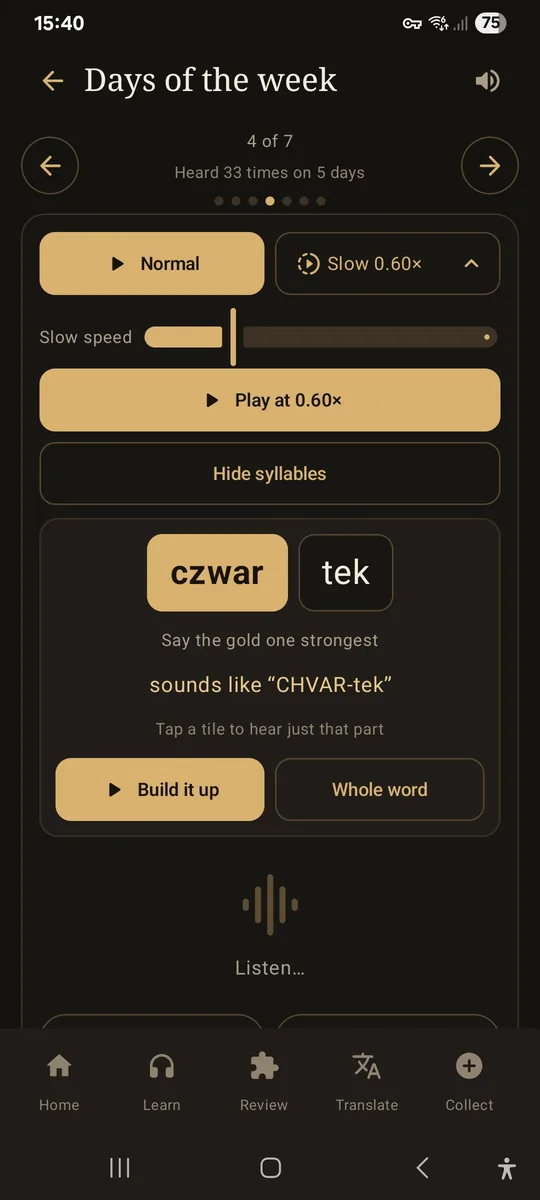
- Break it downSyllable by syllable, stress in gold
- RevealThe spelling, then the English
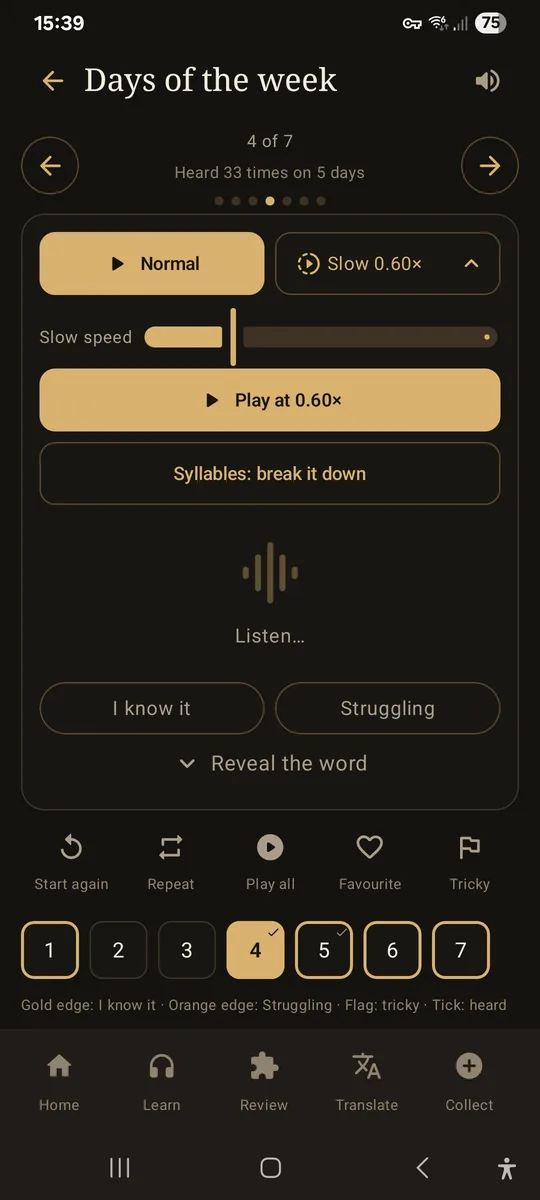
Slow speech keeps its natural pitch, so a slowed word still sounds like a person rather than a recording on a dying battery. Mine is set to 0.60×.
Syllables arrive as tiles. The stressed one is gold, with a plain instruction: say the gold one strongest. Tap a tile to hear only that part, press Build it up to hear the word assembled piece by piece, or Whole word to hear it all again. The tile being spoken lights up as it plays.
One Word, Up Close
Only when you choose Reveal the word does the spelling appear: czwartek, its stress as CZWAR-tek, and how it sounds to an English ear, “CHVAR-tek”.
Even then the English stays hidden behind a mist. One more tap clears it.
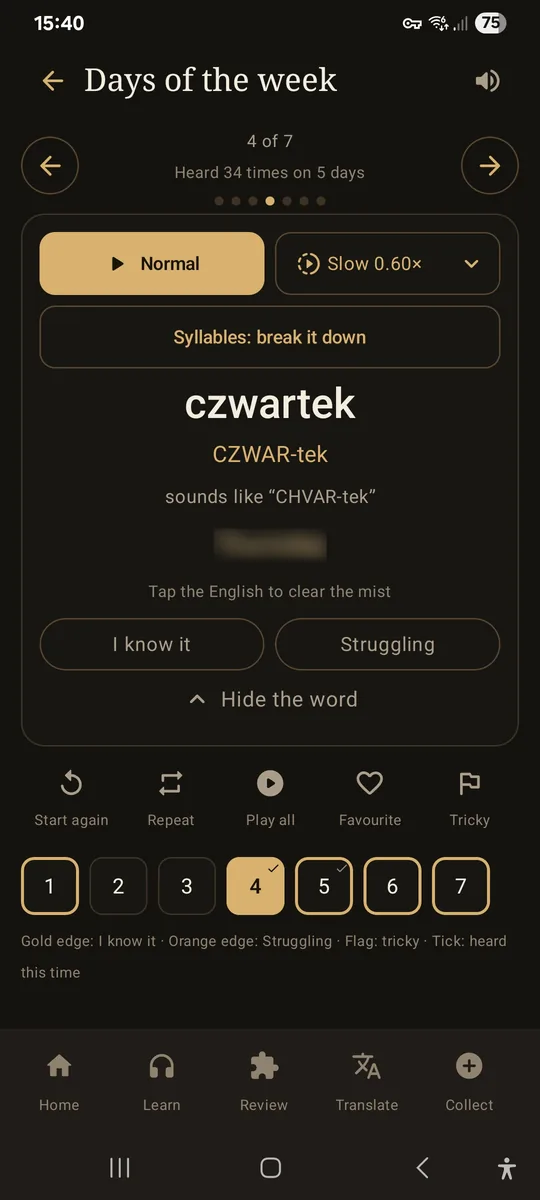
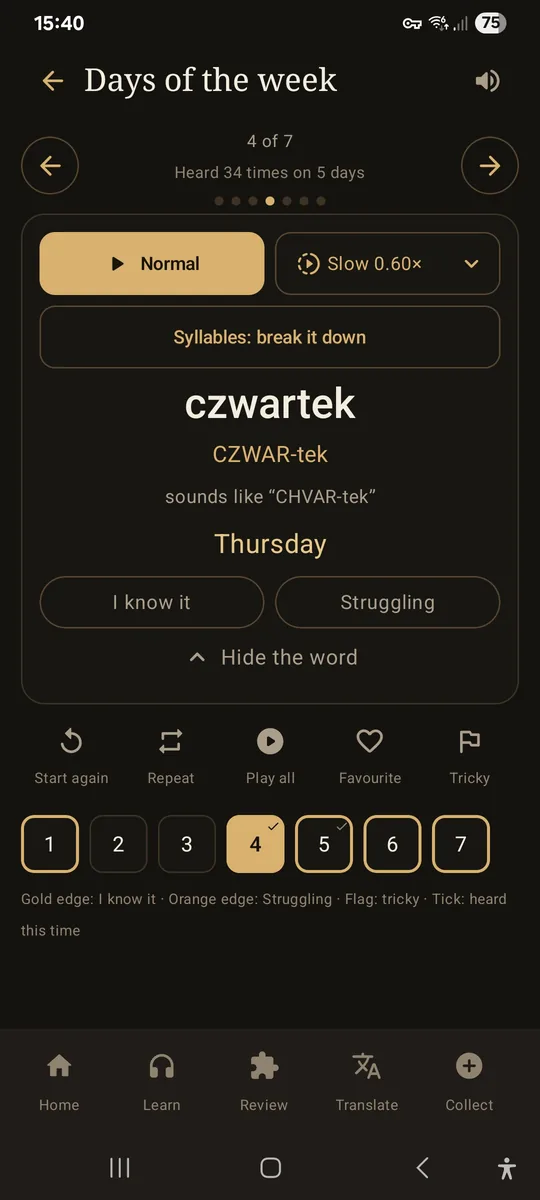
That pause is the whole method in miniature. By the time the meaning appears, you've already tried to recall it, and that effort is what makes it stick.
Small details carry the rest:
- Nothing jumps. The space for the word is reserved, so revealing it never shoves the buttons out from under your thumb.
- Every listen counts. “Heard 34 times on 5 days” tells me more than any score: familiarity is built over days, not in one sitting.
- The row underneath. Start again, Repeat (three times, with pauses), Play all (the Polish, a pause, then the English, then the next word), Favourite and Tricky.
- Numbered tiles. Jump to any word in the category. A tick means heard this time, and the edges show what I've told the app.
The Learner Decides
Most language apps decide for you when you “know” a word, using an algorithm you can't see. Monty Polish doesn't. I considered a spaced-repetition engine and chose against it. Simple and predictable beats clever and opaque.
A gold edge. Familiar enough that it no longer needs focused practice.
An orange edge. It comes first in the next session until I say otherwise.
A flag for words I keep mixing up. Tricky words get their own practice, and stay until I remove them.
Words I want close at hand, grouped by category rather than one long list.
The app can make suggestions, but never decisions. If I miss a word in three Review rounds, it says “These keep slipping away” and offers to add it to Tricky. It's never added automatically, and Not now starts the count again.
A Week at a Time
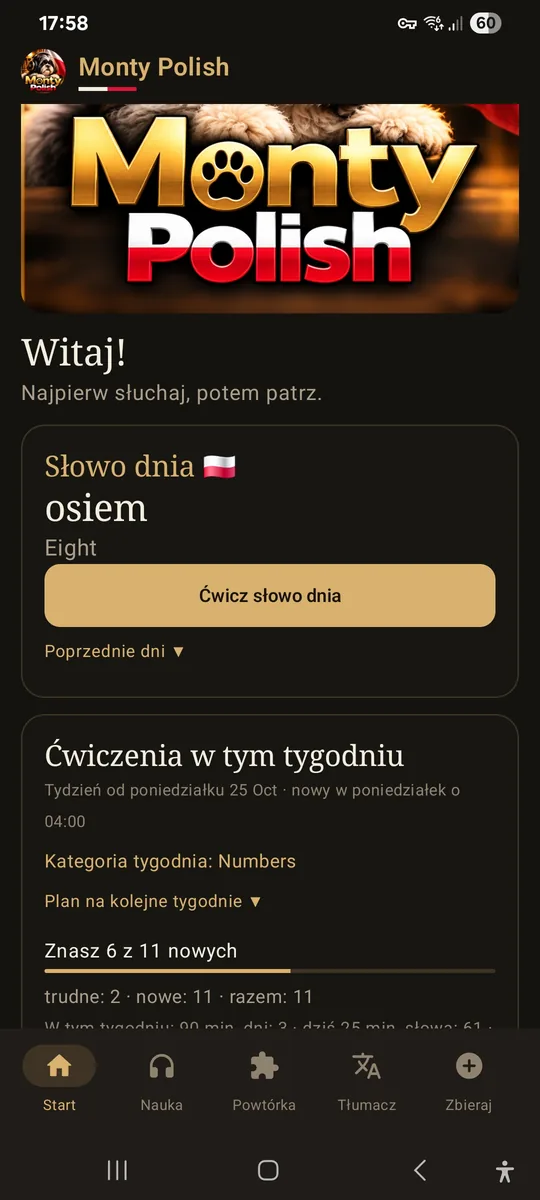
The first version chose new words every day. Twenty new words a day was far too many, so practice became weekly. That was the most important change I made.
- A theme for each week. Every Monday at 04:00 the week's words are chosen and kept for seven days, so there's time to make them yours. My first week was Numbers.
- Plan ahead. I choose a category for each of the next four weeks, or let the app pick the next one I haven't covered.
- Every session in the same order. Struggling words first, then Tricky, then the week's new words, then a few older ones whose turn has come round again.
- A practice day that runs from 04:00 to 04:00, so a late-night session still counts for the day it began.
- Word of the Day, chosen fresh each night from the words already in the app.
- Quiet weeks. Mark a holiday and the streak sleeps instead of breaking. No guilt, no nagging notifications.
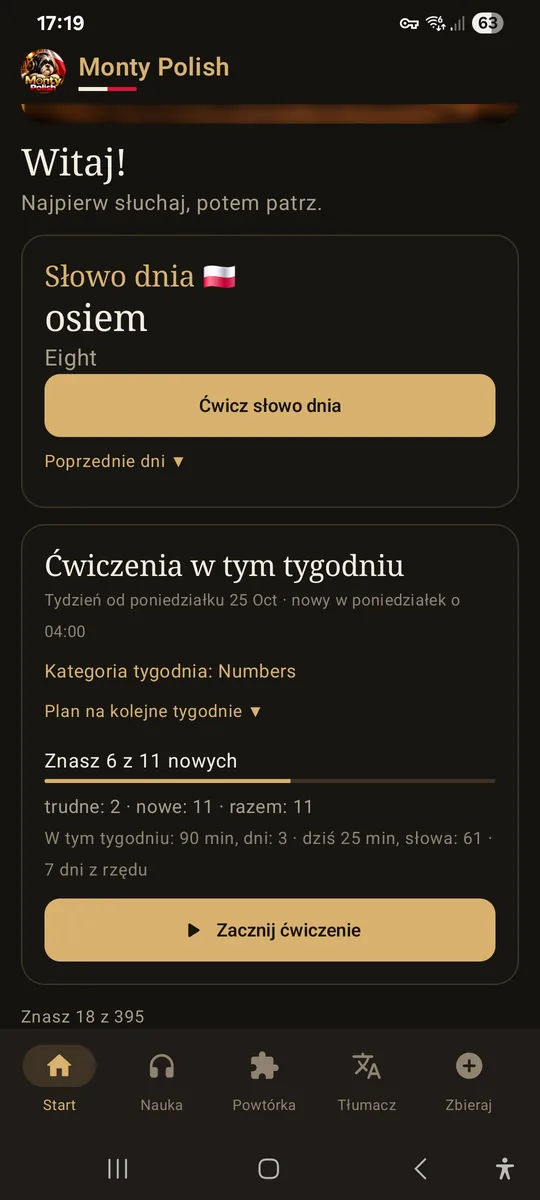
A session starts by itself with the first word played, and ends after a few quiet minutes. It can be measured in words or in minutes, and moving between categories never loses the time.
Review
Listening introduces a word. Review proves it stuck. Version 2.3, released today, turned Review into rounds with a beginning, a middle and an end.
| Mode | You hear | You do |
|---|---|---|
| Meaning | A Polish word | Tap what it means |
| Pairs | Up to seven sounds | Match each sound to its meaning |
| Build | A phrase | Tap the words in the order you heard them |
| Reply | A question | Choose the natural answer, call and response |
- Before: choose words, phrases or both; from everything, this week, Favourites, Tricky or one category; and 10, 20 or 30 questions, drawn at random.
- During: a count that never resets mid-round, and a bar that fills gold for right first time.
- After: the score, the time, last time and your best. Missed words come back once as a second chance, with a play button and a Tricky flag beside each.
Reply exists because of the shop counter. Phrases are taught as call and response, so I know what I'll be asked before I need to answer it.
Voices
In a listening app, the voice is everything. Rather than record words myself, I let the phone's best Polish voices do the work, and gave myself a choice.
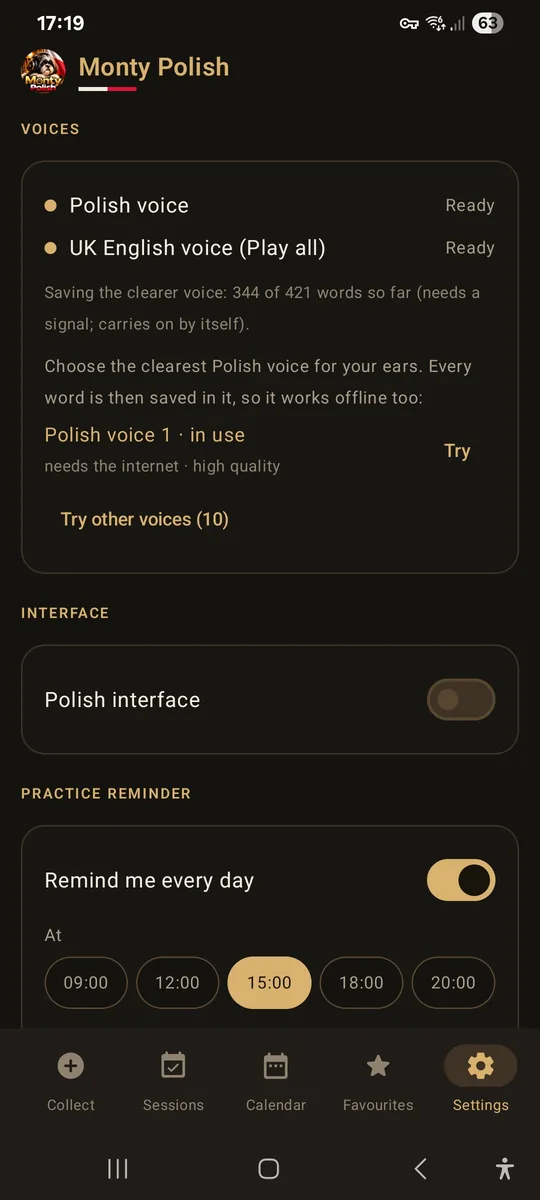
- Choose by ear. Try each Polish voice on the phone and keep the clearest.
- Saved word by word. The chosen voice records every word on the phone in the background, so practice works with no signal at all.
- Two languages. A Polish voice for the words and a UK English voice for the meanings, so Play all works hands-free, like a private language tape.
- The first syllable matters. A short silent lead-in stops Bluetooth headphones and hearing aids swallowing the start of a word, and volume is one tap away on every card.
Living in Polish
Lessons only go so far. The language I need most is the language in front of me today, so the app reaches out into real life.
“What did that sign say?”
Polish and UK English in both directions, with Hear the Polish on every result. The last thirty translations stay in a list, and any of them can be saved into a category.
“I'll need that word again.”
I make my own categories and fill them as life demands: type the English, ask for the Polish, hear it, keep it. New words are ready to play straight away, with the same listening card as everything else.
“Does the radio count?”
Yes. Practice away from the app can be added by hand: radio, shop, talking, TV or other. Real conversations are practice too, and the calendar should say so.
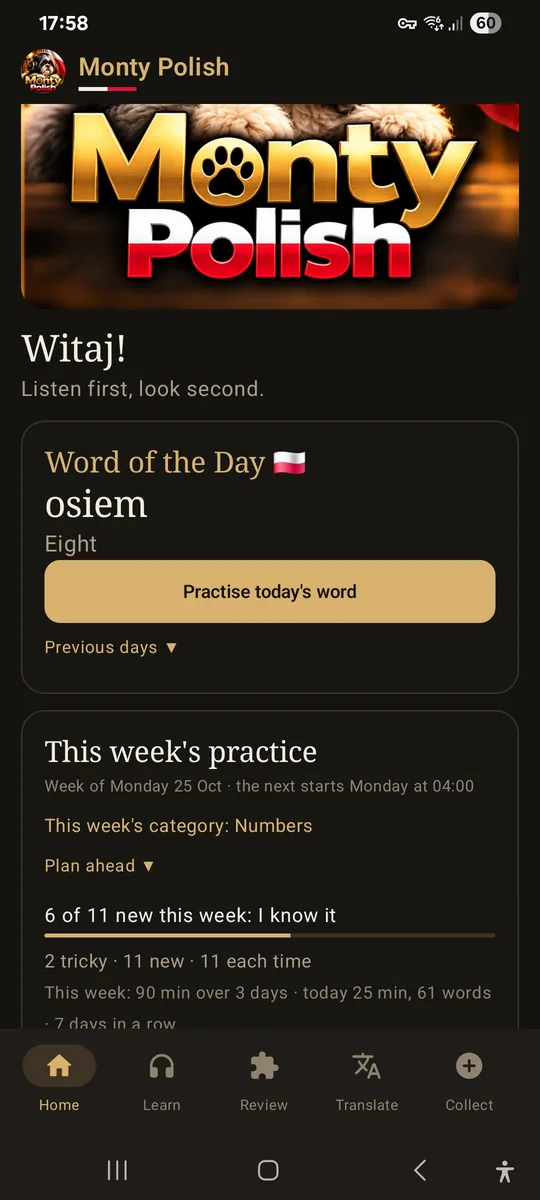
The interface itself can be switched to Polish at any time, with one switch in Settings. Category names stay in English, so I always know where I am, while everything around them slowly becomes Polish.
Behind the Scenes
Monty Polish looks simple on purpose. Underneath, it runs on the same principles as the rest of Monty Network.
- The app: native Android, written in Kotlin, phone first, in the Monty Network colours with a thin Polish flag stripe.
- Its own database: a private Supabase project for every word, phrase, category, listen, mark and session, with one private sign-in.
- Works offline: changes made with no signal wait on the phone and send themselves later, each with its own ID, so nothing is ever doubled.
- Run from Monty Control: words and categories are added, moved and corrected in MC's Polish section on the laptop. The phone notices within ninety seconds, with no new version to install.
- Translation kept safe: DeepL runs behind a server function, so no translation key ever sits on the phone.
- Practice calendar: finished sessions go into a dedicated Monty Polish calendar when I approve them, listing the words heard.
- GitHub decides: the source lives in one repository, and every version is built from it.
That's why changes can happen quickly. Today alone, Months of the Year and Seasons arrived as new categories, every category was split cleanly into words or phrases, and Review rounds shipped as version 2.3.
Results
The only test that matters for an app like this is whether its one user keeps opening it. So far, he does.
The second number surprised me most. I built Slow because I was sure I'd need it. In practice I reach for it on fewer than one play in twenty. Natural speed, heard often enough, does the job, and Slow is a safety net rather than a crutch.
Eighteen words are marked I know it so far, out of 395. That's honest, and it's meant to be. I'd rather know eighteen words when I hear them in the street than recognise four hundred on a screen.
Figures as of 27 October 2026, from the app's own database.
The goal was never a score. It was understanding what someone just said to me.
What's Next
Monty Polish grows the way I learn: one week, one category, one real-life need at a time.
- More of everyday life. New categories as I meet new situations, added from Monty Control or straight from the phone.
- Review in Monty Control. Review rounds and their results, visible from the laptop as well as the phone.
- Still no speaking tests. Some rules aren't up for review.
What I've learnt
Build for one real person, and you can't hide behind a feature list. Twenty new words a day looked good on paper and felt awful in practice, so it changed the same week. Being both the builder and the only user is the fastest feedback loop there is.
And Polish? Still hard. But czwartek is Thursday now, every time I hear it.
Listen first. Look second. Learn naturally.