Overview
Monty Network looks after itself. Every site is watched from outside around the clock, every link is checked each week, and a nightly round covers the basics a site can quietly lose. When something does go wrong, the network opens a ticket with the details, tells me once, and closes the ticket again when it's fixed.
All of it reports to Monty Control, the network's control centre, and like the rest of the network it was designed and built by one person.
This case study covers the layers of watching, how false alarms are kept out, how a problem becomes a ticket, and why most alerts know what time it is.
The Watch at a Glance
Watched from outside, checked from inside, written down every time.
These figures cover the sites in this watch only, not every site and subdomain in the network, so other case studies may show different numbers.
Why I Built It
I'd rather hear about a problem from my own system than from a visitor. A broken link or a site that's down is a small thing to fix and an awkward thing to be told about.
But I also know the network isn't a business. Nobody loses money if a page is down at three in the morning. Fixing it by nine o'clock is fine. So the watch had to be thorough without being frantic: notice everything, and only wake me for the things that can't wait.
The rule I built it around.
Know first. Panic never. Sleep through anything that can wait until morning.
The Challenge
Watching a website is easy. Watching thirteen without drowning in messages is not:
- the internet hiccups, and a check that fails once isn't a site that's down
- one broken link on a page can become forty emails if every check shouts
- heavy sites can take longer to scan than the host allows a job to run
- an alert is only useful if it says what's wrong and where to start
- a message at four in the morning about a broken link helps nobody
Layers of Watching
No single check sees everything, so the watch is built in layers. Each one answers a different question.
- OutsideIs the site answering at all? Checked every five minutes
- InsideIs the site well? Its own health check, read by Monty Control
- LinksDoes every link still lead somewhere? A weekly rota
- BasicsCertificate, tags, robots file and site map, every night
Underneath sit the safety nets: daily backups by the host, every version of the code on GitHub and a mirror drive at home, and a small worker that keeps the network's free databases from falling asleep.
Is It Up?
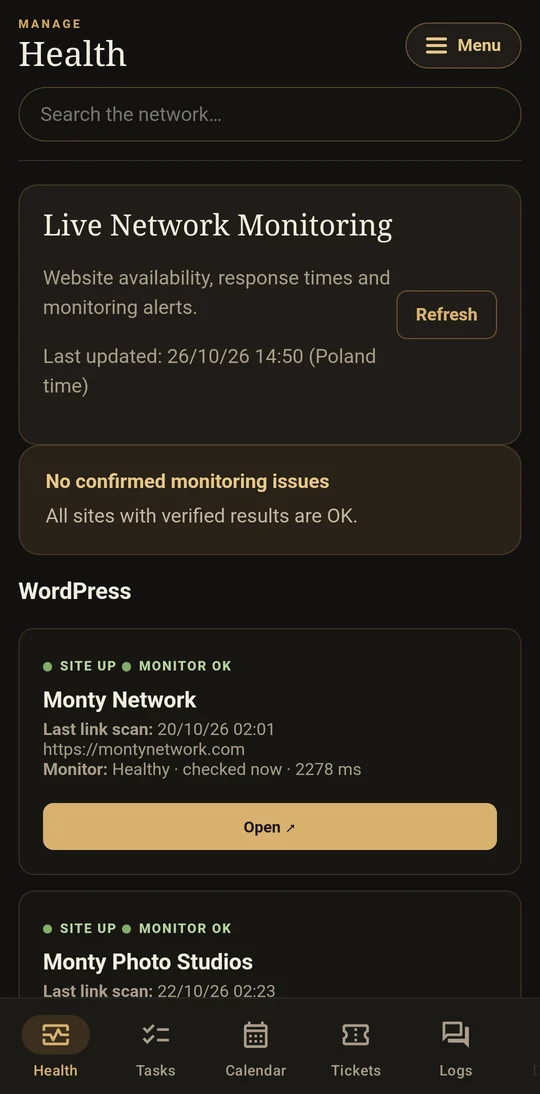
An independent monitor visits every site every five minutes and measures how quickly it answers. If a site stops answering, it sends an email and a Telegram message straight away.
Monty Control also asks each site how it is. Every site has a small health check of its own, and Monty Control reads them all. To keep false alarms out, it's patient:
- a failed check is tried again before it counts as a failure
- an incident opens only after three failed runs in a row
- and only once the site has been failing for around ten minutes
A blip that fixes itself never becomes a message. A site that's really down always does, at any hour.
Every Link, Every Week
Broken links quietly damage a site. The Link Checker finds them before visitors do, crawling every page of every site over a seven-night rota in the small hours.
| Night | Sites |
|---|---|
| Tuesday | montynetwork.com, Monty Help, Monty Check |
| Wednesday | montysounds.com, Monty Select |
| Thursday | montyphotostudios.com, on its own |
| Friday | montysoundsradio.com, Monty Stats |
| Saturday | Monty Subscribe, Monty Search |
| Sunday | Monty ID, the Sandbox, Monty Lounge, Monty Contact |
- Heavy sites get a night to themselves, and are scanned in short stages so no single job runs longer than the host allows.
- A broken link is checked again before anything is raised, so a slow server elsewhere doesn't cause a false alarm.
- Every result is written down in a weekly thread in Monty Control, and real faults become tickets.
Two sites are left off on purpose: Monty Listen and its app version carry more than four hundred tracks each, and checking every one every week would be noise, not care.
Tickets That Write Themselves
When a fault is confirmed, nobody has to write it down. The network does.
- FoundA check fails, and keeps failing
- TicketedA ticket opens with the details and the address
- ToldOne email and one Telegram message
- ClosedOnce fixed, the ticket closes and an all-clear follows
- One numbering for everything. Monitoring tickets share their numbers with my job tickets, so a number is never used twice and searching for one always finds it.
- Help is one click away. Each ticket has its details prepared for an AI assistant: one click copies them, so ChatGPT or Claude can help work out the fix. The assistant advises. I decide and I fix.
- A record that stays. When a ticket closes, its notes go into Monty Control's logs, so the next time the same thing happens, the answer is already written.
The job tickets themselves, the ones I work from at the laptop, have a case study of their own: The Ticket Method.
Alerts That Know What Time It Is
Not every problem deserves the same voice.
Speaks up at once
- A site or app that stops answering
- A health check that keeps failing
- At any hour of the day or night
Waits for morning
- Broken links found overnight
- Grouped into one message per site, new and fixed together
- Held between 20:00 and 06:00, then sent
Broken-link tickets open and close quietly. The announcement comes later, as one summary for each site, listing everything newly broken and everything mended since the last one. A ticket that opens and closes again overnight never makes a sound, and no summary is ever sent twice.
The Nightly Round
Some things break so quietly that no visitor would ever notice, until a search engine does. So every night Monty Control walks the network and checks the basics on every site:
- Site up
- Certificate valid
- Links scanned
- Home page tags
- robots.txt
- Site map
- Once a week, it writes a short ticket: a glance across the whole network, and any automatic check that's failing.
- Once a month, it writes another, with the slower checks that only need doing now and then, and the quarterly ones when they fall due.
- When nothing's due, it writes nothing at all.
It's the same checklist every site goes through when it's built or moved, so nothing learnt once is ever forgotten.
Results
The watch has changed how problems arrive. They come with a number, an address and a place to start, and many can be fixed before a visitor would ever notice.
When the sites moved off WordPress in November 2026, the watch moved with them: each new site was on the rota, answering its health check and reporting its stats before the old one stepped aside. That story is in Leaving WordPress.
Figures as of 12 November 2026, from Monty Control. These figures cover the sites in this watch only, not every site and subdomain in the network, so other case studies may show different numbers.
What's Next
- One clock for every job. The overnight jobs are moving into Monty Cron, my own scheduling service, so the whole watch runs on a timetable I can see in one place.
- The same care for new sites. Anything new joins the watch on the day it goes live.
Read more
- Health monitoringEvery site checked every five minutesRead →
- Link CheckerEvery link, every weekRead →
- Issue ticketsProblems that explain themselvesRead →
- Monty ControlWhere all of it reportsRead →
What I've learnt
The best alert is the one that knows when to keep quiet. Being told everything isn't the same as knowing what matters.
Always watching. Rarely shouting.
Built for my own network — this isn’t a public product. Want sites that watch themselves like this? I build bespoke.
Contact us ↗