Overview
The Conversation is two Monty Sounds songs that belong together. In "Just For You" a woman sings to someone she has never met: someone who smiles for everyone, then falls apart once the door is locked. In "I Heard Your Song" a man finds her song at half past three in the morning and sings back.
Only one of them was planned. The first was written to stand alone, as a song of hope. The second came later, when the finished first song told me it was half of something.
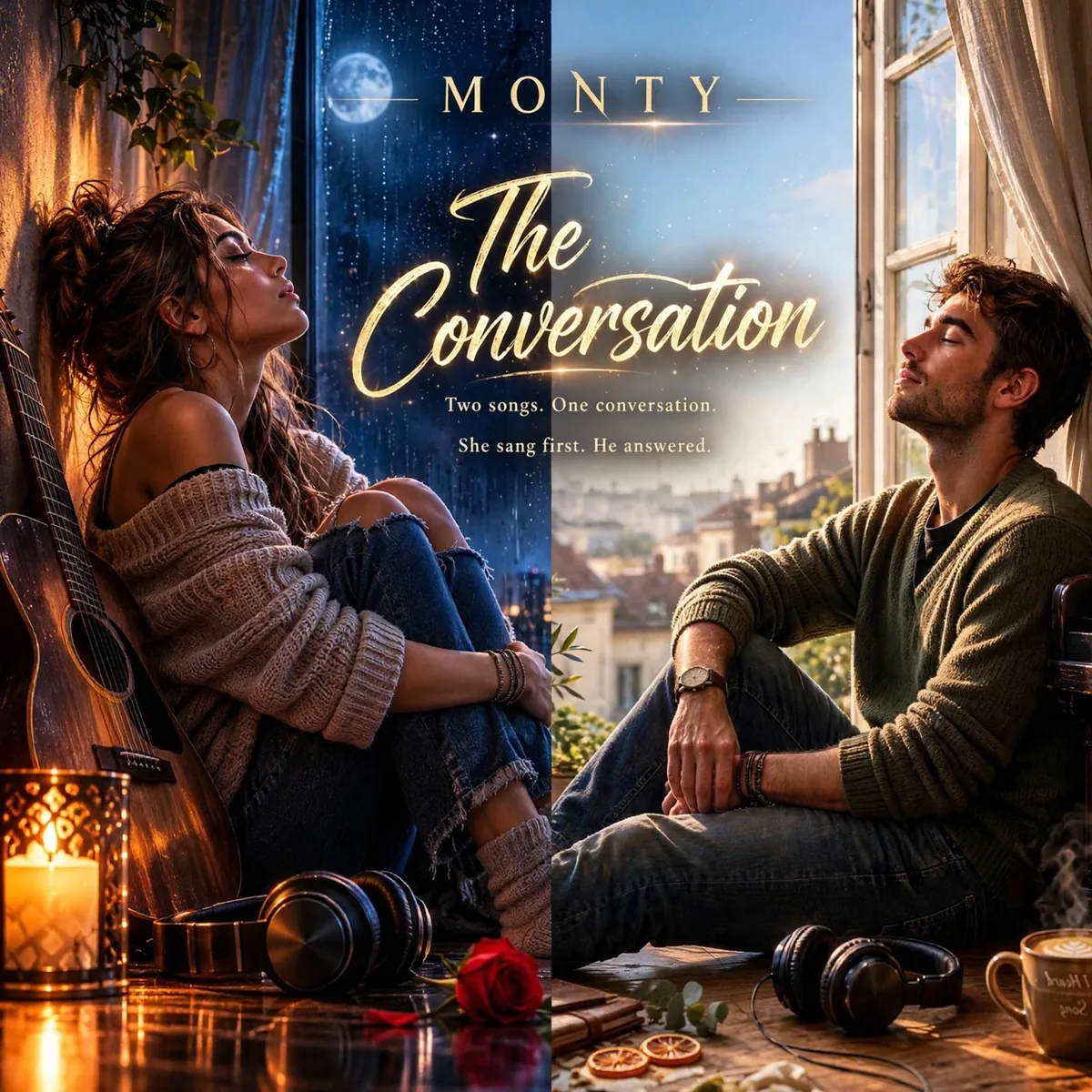
This case study is the story of that turn: why I wrote her song, the moment it changed, the rules I set for his reply, and how the two now live together across the network.
The Conversation at a Glance
A song that didn't know it was a question, and the answer it found.
Why I Wrote It
Some people are the strongest person in every room, right up until the door closes behind them. "Just For You" is for them.
You smile for them, then lock the door,
And fall apart on the bathroom floor.

I wrote it as a track of hope for anyone in that place. She doesn't know who's listening, and she doesn't need to. She simply tells them that someone saw the pain nobody else did, and that the night will end.
The only aim.
Hope, for whoever needed it that night. It was never written to be answered.
The Moment It Changed
A song isn't finished when the words are. I kept going back to it, amending the lyrics, then the track, then the lyrics again, until the sound was right.
Then I listened to the final release the way a stranger would, and heard it differently. She sings to someone she has never met. She gives him the song to keep. And she stops in the dark, before morning comes.
A song that ends like that is waiting for something. So the question was no longer what she was saying. It was who was listening, and what he would say if he could answer.
She sings. He replies. That was the whole idea, and it arrived after the song was already out.
The Rules of an Answer
Writing a reply is harder than writing a song. Her story was already out in the world and couldn't change, so his had to fit it exactly. I set myself three rules.
- It has to answer her, not copy her. The same shape, the same rhyme scheme, the same places for verses and chorus, so the two line up like question and answer. But every line had to be his own.
- His story has to match hers. She describes someone who hides it all, the doors that slammed and the calls never made. He is that person: curtains drawn for weeks, the phone dark, the tea gone cold.
- He gets the morning she held back. Her song covers every sleepless night. His begins on one night in particular, at half past three, and ends with the window open and the morning let in.

She sings
- To a stranger she can't name
- Every night, in the dark
- "It's yours to keep"
- Ends before dawn
He answers
- To the voice that found him
- One night, at half past three
- "Let me sing it back to you"
- Lets the morning in
Her Words, Turned Round
The secret of the reply is in a handful of lines where he takes her words and changes almost nothing. That's what makes it sound like an answer, rather than another song.
She: "For every night you couldn't sleep."
He: "For every soul who couldn't sleep."
She sang to one person. He passes it on to everyone.
She: "When all is quiet, all is through."
He: "When all is quiet, all is new."
Her last word closes a door. His opens one. And her final line, "This song was always just for you", gets its reply in the very last line he sings: "This song is my reply to you."
The Week Between
"Just For You" was released on 17 November. "I Heard Your Song" followed on 22 November. That gap wasn't spare time. It was the work.
Every line of his had to be checked against hers: does it answer something she said, does it fit the person she described, does it keep to the same shape. A reply that drifts from the first story stops being a reply. Getting both the words and the sound to match took the best part of a week.
Two Songs, One Conversation
I could have joined them into one long track. I chose not to. Someone might only ever find one of them, at the hour they need it, so each song still has to stand on its own.
Instead they meet in a playlist. Press play on The Conversation on Listen and they run in order, her first, then him. Share the link and whoever opens it hears the whole exchange, in the order it happened.
- The ConversationBoth songs, in order, on ListenPlay ↗
- Just For YouHer song, 17 NovemberPlay ↗
- I Heard Your SongHis reply, 22 NovemberPlay ↗
- The SoundCloud setThe pair, side by sideListen ↗
Both are on Monty Sounds Radio too, so somewhere in the small hours the station may play her song, and later his, to someone who has no idea they're hearing a conversation.
Behind the Scenes
Neither song needed anything special to be released. Each one took the same road as every other Monty Sounds track.
- One row in Notion each. Title, release date, artwork, audio and the full lyrics live in the track's row. Notion is the source of truth.
- A page on Listen. Each song has its own track page with its lyrics, so the words are there for anyone who wants to read along.
- A short link each. tk.montysounds.com links that show the song's cover wherever they're shared.
- A playlist that previews itself. The Conversation's link shows its name and artwork when it's shared, so the pair travels as one.
- The story in the Lounge. The Monty Lounge post invites listeners into the songs; this case study keeps the record of how they came about.
The network was built so the music could move fast. The Conversation is what that looks like: her song out on the 17th, his reply out on the 22nd, and each one everywhere on the day it was released.
Results
Her song found its listeners first, which is how it should be. His reply is still finding the people who heard her.
SoundCloud figures as of 25 November 2026, from Monty Stats. They cover these two songs only.
What's Next
He ends by offering to sing it back. So the conversation doesn't really close. It waits for the next person awake at half past three.
- Your answer. The Lounge post asks which song you'd send to a stranger, and what you would say to him. Some of the best replies may not be songs at all.
- Both songs keep travelling. On the radio, on Listen and in the playlist, they'll keep finding people at the hour they need them.
What I've learnt
A song can know things its writer doesn't. I wrote "Just For You" to stand alone, and it was only by listening to it as someone else would that I heard it was waiting for an answer.
If tonight feels like one of those nights, you don't have to get through it alone. In the UK, Samaritans are there day and night on 116 123.
She sang. He answered. Your turn.
Written, released and shared through my own network. Want a home like Listen for your music? I build bespoke.
Contact us ↗